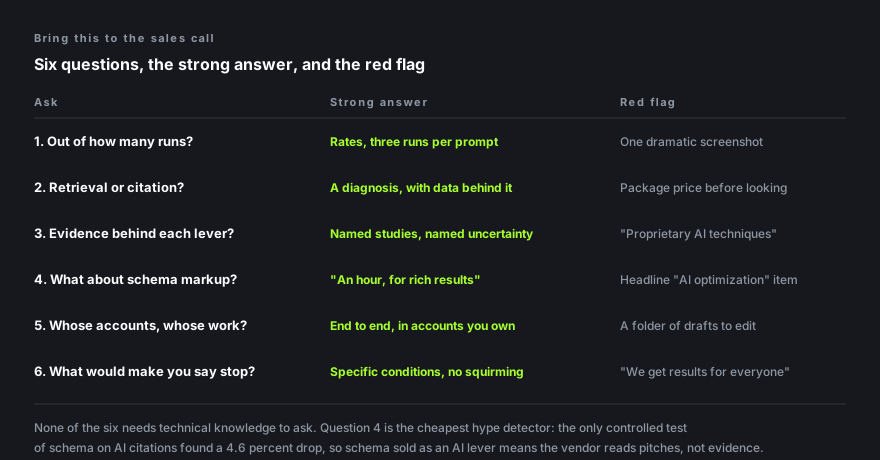
Six questions will tell you more about an AI SEO agency than any case study they show you: out of how many runs is that screenshot, is my problem retrieval or citation, what evidence backs each thing you sell, what will you do about schema markup, who publishes the work and in whose accounts, and what would make you tell me to stop paying you. We are an agency, so we wrote the exam we would want to sit. Every question below comes with the strong answer and the red flag, and you are welcome to use all six on us.
1. "Out of how many runs?"
Ask this the moment anyone shows you a screenshot of ChatGPT recommending a competitor, or of their own client being named. AI engines answer the same question differently on different runs, so a finding without a denominator is a screenshot, and screenshots are how this industry sells fear. Strong answer: "three runs per prompt per engine, here are the rates." Red flag: a single dramatic capture, or a blank look.
2. "Is my problem retrieval or citation?"
These are two different diseases with two different price tags. If engines never fetch your pages, the work is technical and comparatively cheap. If they read you and still name someone else, the work is content and mentions, which costs more and takes longer. An agency that cannot tell you which failure you have is proposing surgery without an x-ray. Strong answer: a diagnosis with data behind it. Red flag: a package price quoted before anyone looked.
3. "What evidence backs each thing in the proposal?"
The honest hierarchy runs from controlled experiments down to vendor folklore, and most of what moves AI visibility has a known tier. On-page quotability has a controlled study behind it. Rank and brand mentions have large-scale correlations. Freshness has platform statements. Anything beyond that list is being sold on confidence. Strong answer: the agency names its evidence and its uncertainty. Red flag: "proprietary AI optimization techniques" that cannot be described.
4. "What will you do about schema markup?"
This one is a trap, and it is the cheapest hype detector available. The only controlled test of schema's effect on AI citations, run by Ahrefs, found pages that added schema lost 4.6 percent of their AI Overview citations, and no study shows a positive citation effect. Schema still earns rich results in classic search and costs about an hour to do properly. Strong answer: "an hour of work, for rich results, not for AI." Red flag: schema as a headline deliverable on an "AI optimization" invoice.
The schema question costs you nothing to ask and tells you immediately whether the agency reads evidence or sells folklore.
5. "Who does the work, and in whose accounts?"
Two failure modes hide here. First, some vendors hand your team AI-drafted content and call it a service; you are paying for drafts your staff still has to edit and publish. Second, some agencies build everything inside accounts they own, so leaving them means starting over. Strong answer: the agency does the work end to end, in properties you own, with you as the approver. Red flag: your "deliverable" is a shared folder of drafts, or an analytics login you were never given.
6. "What would make you tell me to stop paying you?"
An honest agency has real answers: no search demand in your niche, customer value that never repays the spend, a channel mix where referrals already win. SEO is not worth it for every business, and a vendor who cannot describe the client they would turn away is telling you that your fit was never evaluated. Strong answer: specific conditions, stated without squirming. Red flag: "we get results for everyone."
Questions owners ask us
Is GEO different from AEO? Do I need both?
Two names for the same work: getting AI engines to name your business. GEO stands for generative engine optimization, AEO for answer engine optimization. An agency selling them as separate line items is billing twice for one job.
Do I need a separate AI agency alongside my SEO agency?
Usually not. The levers with evidence behind them are crawler access, rankings, quotable copy, and brand mentions, and a competent SEO agency already works most of that list. What you need is honest AI-citation measurement, not a second retainer.
An agency guaranteed we will be ChatGPT's answer. Good sign?
The opposite. AI answers are probabilistic, so nobody can guarantee a specific answer, only raise your appearance rate. A guarantee about a probabilistic system is either ignorance of the system or a bet that you will not measure the result.
What should we own if we leave after six months?
Everything: the site, the content, the Search Console and analytics properties, the measurement history. Agencies should be added users on your accounts, never the owners. Ask this before signing and get it in writing, because it is the question that costs the most to ask late.
Sit us for the exam
The free audit answers questions one and two before you have paid anything: your appearance rates and whether your problem is retrieval or citation.
Get my free auditSources
- Ahrefs, "We Studied the Effect of Schema on AI Citations": ahrefs.com/blog/schema-ai-citations
- Aggarwal et al., "GEO: Generative Engine Optimization" (KDD 2024): arxiv.org/abs/2311.09735
- Ahrefs, "An Analysis of AI Overview Brand Visibility Factors (75K Brands Studied)": ahrefs.com/blog/ai-overview-brand-correlation
- Google Search Central, "Do you need an SEO?" (Google's own guidance on vetting SEO hires): developers.google.com