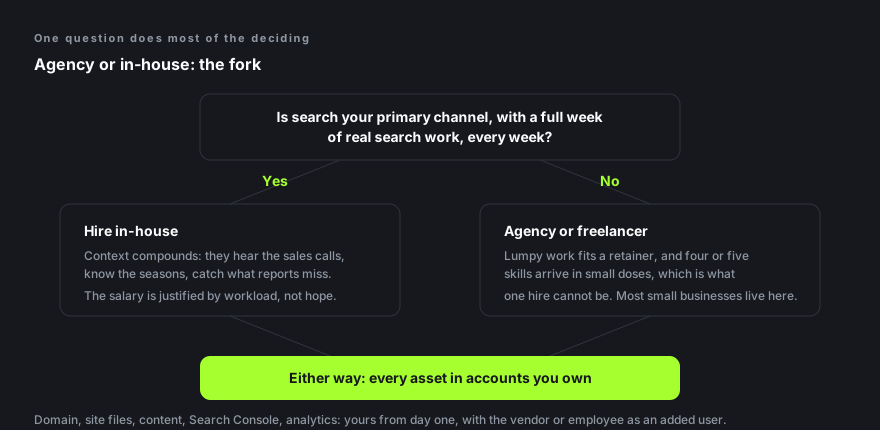
Hire in-house when search is your primary customer channel and there is a full week of real search work to do, every week. Below that line, an agency or a strong freelancer costs less and covers more skills than one hire can. We sell the agency side of this argument, so weigh what follows accordingly; the test we propose is one you can run against us too. The deciding variable is not company size. It is how many hours of genuine search work your business generates, and who can do all of them well.
The real cost comparison
An in-house hire costs a full-time salary plus tools, and search salaries vary too much by market for a useful single number here; check current listings in your city for the honest figure. What matters more than the number is the shape of the cost: a salary buys you forty hours of one person's skill profile, whether or not your business generates forty hours of search work. An agency retainer buys fewer hours, spread across more specialties, and it scales down when the workload does.
The hidden cost runs the other way too. Agencies split attention across clients, and you are one of many. An in-house person compounds context about your business that no agency matches: they hear the sales calls, know the seasonal rhythm, and catch opportunities a monthly report never surfaces.
When in-house wins
In-house is the right call when search is the channel your revenue depends on and the work list stays full: an e-commerce catalog with hundreds of pages to maintain, a content operation publishing weekly, a lead-generation engine where a ranking slip costs real money that week. In those businesses the compounding context of a dedicated person beats an agency's breadth, and the salary is justified by the volume of work, not by optimism about it.
The common failure is hiring for the title before the workload exists. A full-time search hire at a ten-person service business often spends most of the week inventing work to look busy, because the site needed twenty hours a month, not forty a week.
When an agency wins
An agency wins below that line, which is where most small businesses live. The work a small site actually needs is lumpy: a technical fix this month, three articles next month, a measurement question the month after. That pattern fits a retainer or a project engagement, and it needs four or five different skills in small doses, which is exactly what one hire cannot be.
The characteristic agency failure is misalignment: a vendor paid monthly has an incentive to make the work look perpetual. The fix is structural. Insist on deliverables in your accounts, rates with denominators instead of screenshots, and a vendor who can name the conditions under which they would tell you to stop. We wrote the six questions that test for this, and they work on us too.
The deciding variable is not company size. It is how many hours of genuine search work your business generates, and who can do all of them well.
The rule that applies to both
Whichever way you go, structure it so nothing is hostage. Domain, site files, content, Search Console, analytics: all owned by you, from day one, with the agency or employee as an added user. This costs nothing to set up at the start and can cost you the entire asset at the end. It also keeps everyone honest, because a vendor who can be replaced without losses has to earn the renewal on results.
And before choosing either, run the arithmetic on whether to spend at all. SEO is not worth it for every small business, and the cheapest option is knowing that before the first invoice.
Questions owners ask us
Can my part-time marketing person just do the SEO?
They can own pieces of it: publishing, local listings, review requests. The parts that go wrong quietly are technical crawlability, measurement, and knowing which levers have evidence behind them. A common split is your person producing content while an agency or consultant handles the technical layer and checks the numbers.
How do I keep an agency honest?
Deliverables in accounts you own, rates with denominators instead of screenshots, and a written list of what was done each month. An agency that resists any of those three is telling you how the relationship ends.
What about freelancers as a middle path?
Often the best value below agency scale, with the same vetting questions applying. The tradeoffs are coverage and continuity: one person, one skill profile, and no backup if they disappear mid-engagement. A freelancer who covers your needs and answers the vetting questions well is a legitimate choice, not a compromise.
If we leave our agency, what should we walk away with?
Everything: domain, site files, content, Search Console and analytics with you as owner, and the measurement history. Set this up on day one. If any asset would not survive the relationship ending, it was never yours.
Start with the diagnosis, not the hire
The free audit tells you what work your site actually needs, which is the number this whole decision turns on. Bring the result to any agency, including us.
Get my free auditSources
- Google Search Central, "Do you need an SEO?" (Google's guidance on hiring for search, including the questions to ask): developers.google.com
- This article gives no salary or retainer figures on purpose: both vary by market and go stale fast. Where we describe cost, we describe its structure, which does not.