Five things have real evidence behind them for getting named in AI answers: letting the AI crawlers read your site, ranking in ordinary search, putting quotable statistics and sources in your visible copy, being mentioned by name across the web, and keeping pages current. The strength of the evidence differs a lot between those five, and this article labels each claim with the tier of proof behind it, because the AI visibility industry runs on confident claims with no proof at all. One thing with strong evidence against it as a citation lever is schema markup, which we cover separately.
How we grade evidence
Before the list, the grading scale. We hold our own claims to it too.
- Tier 1: controlled experiments. Someone changed a thing, kept a control group, and measured. Rare and precious.
- Tier 2: large-scale correlations. Patterns across thousands of sites. Real signal, but correlation is not proof of cause.
- Tier 3: platform statements. What Google, OpenAI and Microsoft say about their own systems. Honest but self-described.
- Tier 4: practitioner observation. What we and others see in the field. Useful for hypotheses, never for certainty.
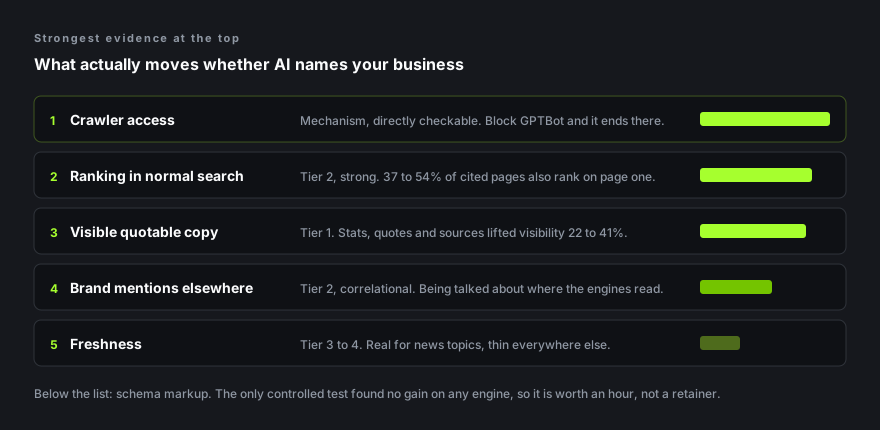
1. Crawler access (mechanism, directly checkable)
This one is not statistical at all. If your site blocks OAI-SearchBot, PerplexityBot or Claude-SearchBot, the agents that fetch for search results and live answers, those systems cannot fetch your pages at answer time, and everything else on this list is irrelevant. GPTBot and ClaudeBot are training crawlers, and blocking them is a separate decision with different consequences, since it governs training data and leaves citation eligibility alone. Many sites block AI crawlers by accident, through a firewall rule, a bot-protection default, or a robots.txt line someone added in 2023 and forgot. It is the first thing we check in every audit, because it is the only factor that is binary, free to fix, and verifiable in minutes. Here is how to check your own site in five minutes.
2. Ranking in normal search (Tier 2, strong)
AI engines search before they answer, using the same indexes you already compete in. Between 37 and 54 percent of Google AI Overview citations rank in the organic top 10, depending on whose study you read: Ahrefs measured 37.1 percent across 4 million cited URLs, Originality.AI found 52 percent on health and finance queries, counting only citations that already rank in the top 100, and BrightEdge reports 54 percent on the keywords it tracks. The studies disagree because they sample different queries with different methods, so we quote the range and not a favorite number. Even at the low end, rank remains the single widest door into AI answers, which is why normal SEO is still the best AI visibility investment.
Want this list scored against your own site, in priority order? That is exactly what the free audit produces.
Get my free audit3. Visible, quotable answer copy (Tier 1)
The only Tier 1 positive evidence in this field. The GEO study from Princeton, Georgia Tech and IIT Delhi, published at KDD 2024, tested nine ways of editing a page and measured its share of AI answers across 10,000 queries. Adding quotations, statistics and cited sources to visible text lifted a page's word share in AI answers by 30 to 40 percent. On live Perplexity the best method, quotations, gained 22 percent.
In plain terms: pages that state numbers, quote named sources, and give a direct answer get cited more. This page is written that way on purpose. It is the cheapest lever on the list because it only requires editing pages you already own.
4. Brand mentions across the web (Tier 2)
Ahrefs studied 75,000 brands and asked which signals predict showing up in AI answers. Mentions of the brand name across the web correlated at 0.664. Classic backlinks, the currency of twenty years of SEO, correlated at 0.218.
Brand mentions correlate with AI visibility three times more strongly than backlinks do.
Branded anchor text came in at 0.527 and branded search volume at 0.392. This is correlation, so part of it is surely just "known brands get talked about and cited for the same underlying reason." But the direction is consistent across every study we have seen: engines name businesses the web already talks about. PR, reviews, directories, podcasts and video all feed this in ways a link-building campaign does not.
5. Freshness (Tier 3-4)
The weakest evidence on the list, flagged as such. Microsoft's Fabrice Canel has said Bing's generative systems value fresh content as a check on their training data, which is a Tier 3 platform statement. Our own Tier 4 observation matches: pages with current dates and current-year numbers get picked over stale ones covering the same ground. Treat it as a tiebreaker, worth a quarterly refresh pass on pages you care about, and not as a strategy.
Where we would spend, in order
- Unblock the crawlers. Free, binary, and nothing works without it.
- Normal SEO on the pages that match buying questions. Widest door, strongest data.
- Rewrite key pages for quotability: stated answers, visible numbers, named sources. The one Tier 1 lever.
- Earn brand mentions anywhere credible. Slowest, and the strongest correlate at the brand level.
- Keep it fresh. Cheap tiebreaker.
- Schema last, priced at the hour it takes, for rich results rather than for AI.
Find out which lever your business needs first
The free audit checks crawler access, retrieval and citations across the major engines, and tells you where the gap is.
Get my free auditSources
- Ahrefs, "An Analysis of AI Overview Brand Visibility Factors (75K Brands Studied)": ahrefs.com/blog/ai-overview-brand-correlation
- Ahrefs, "38% of AI Overview Citations Pull From The Top 10": ahrefs.com/blog/ai-overview-citations-top-10
- Originality.AI, Google ranking and AI citations study: originality.ai/blog/google-ranking-ai-citations-study
- BrightEdge, "Rank Overlap After 16 Months of AIO": brightedge.com
- Aggarwal et al., "GEO: Generative Engine Optimization" (KDD 2024): arxiv.org/abs/2311.09735
- Search Engine Land, "Microsoft Bing, Copilot use schema for its LLMs" (Canel on freshness): searchengineland.com
- Ahrefs, "We Studied the Effect of Schema on AI Citations": ahrefs.com/blog/schema-ai-citations