If you have one dollar to spend on getting named by AI, spend it on ordinary SEO. Google's own documentation says there are "no additional requirements to appear in AI Overviews or AI Mode." The independent data agrees: between 37 and 54 percent of the pages cited in Google's AI answers rank in the organic top 10, depending on the study, which makes ordinary ranking the single widest door into AI citations that exists. An agency selling you "GEO" as a replacement for SEO is selling you the roof before the walls. GEO is real work, and it sits on top of search visibility.
Google said the quiet part out loud
The clearest statement in this whole field comes from Google's documentation for site owners on AI features. It says there are no additional requirements to appear in AI Overviews or AI Mode, no special files or markup to add, and that existing SEO fundamentals "continue to be worthwhile." Platform statements are self-described, and we grade them accordingly in our evidence tiers. This one happens to match everything measurable from the outside.
What the citation data shows
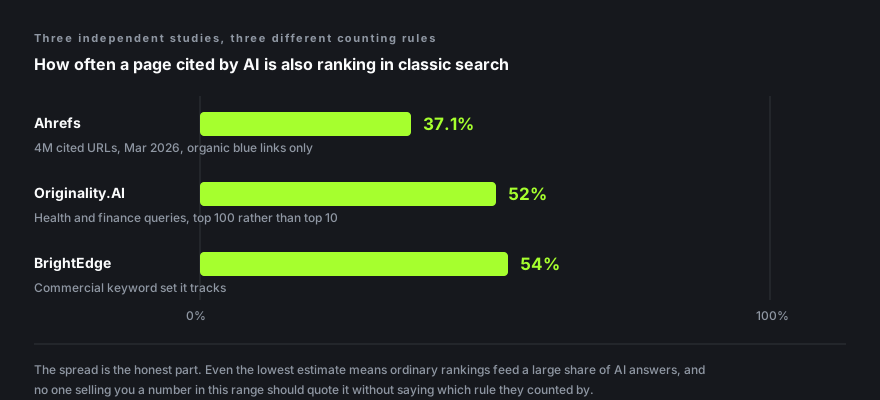
Three independent studies have measured how much AI Overview citations overlap with ordinary top-10 rankings, and they disagree enough that quoting any single number is cherry-picking:
The spread comes from different query samples and different counting rules. So the honest claim is a range: roughly 37 to 54 percent of AI citations rank in the visible top 10. Read it from the buyer's side. No other single factor gets you anywhere near a coin-flip's chance of being in the citation pool. The Ahrefs number is also the newest and the lowest, and it fell from about 76 percent in July 2025, so the door is narrowing. That trend is fan-out doing its work, and the sensible response is to rank for more of the narrow queries fan-out generates.
Ranking in the top 10 is still the widest single door into AI citations, and it is a door you already know how to open.
Want to know whether your pages are the ones the engines read? The free audit checks both scoreboards at once.
Get my free auditThe engines search before they speak
There is a structural reason the overlap exists. When assistants need current information, they run searches against existing indexes: ChatGPT and Copilot lean on Bing, Google's AI features draw on Google. A site that is crawlable, fast, indexed, and ranking for the small specific queries in its niche is exactly the site those searches surface. Every hour of technical and content SEO you have ever paid for is compounding into this new channel at no extra charge.
What "normal SEO" means here, concretely
- Crawlable and indexed, with the AI crawlers allowed in alongside Googlebot.
- A page per real question. Fan-out rewards sites that cover the narrow queries, and those pages are classic SEO inventory.
- Links and mentions from places that carry weight in your industry.
- Speed and sane structure, the unglamorous work that decides whether fetchers bother with you.
Where GEO earns its keep
Once the SEO base exists, the GEO layer is what converts being read into being named: stating answers plainly, putting statistics and named sources in the visible copy, and earning brand mentions beyond your own site. In the GEO paper's controlled tests (KDD 2024), adding quotations, statistics and cited sources to visible text lifted a page's word share in AI answers by 30 to 40 percent. On live Perplexity the best method, quotations, gained 22 percent. This layer is where we spend most of our editing time for clients. The order matters. A page nobody retrieves cannot be cited no matter how quotable it is, and retrieval is won with ordinary search visibility.
Find out if your SEO is already feeding AI answers
The free audit shows whether the engines retrieve your pages today, and who they name instead of you when they answer.
Get my free auditSources
- Google Search Central, "AI features and your website": developers.google.com
- Ahrefs, "38% of AI Overview Citations Pull From The Top 10" (March 2026): ahrefs.com/blog/ai-overview-citations-top-10
- Originality.AI, Google ranking and AI citations study: originality.ai/blog/google-ranking-ai-citations-study
- BrightEdge, "Rank Overlap After 16 Months of AIO": brightedge.com
- Aggarwal et al., "GEO: Generative Engine Optimization" (KDD 2024): arxiv.org/abs/2311.09735