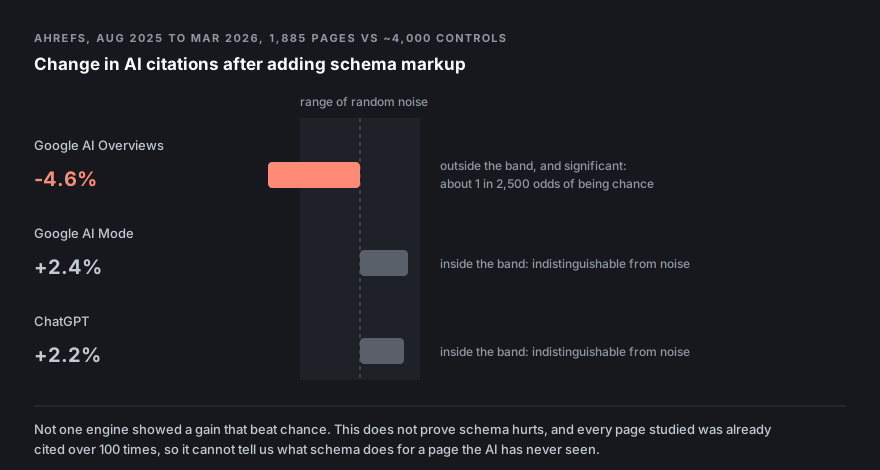
Mostly, no. The most careful test anyone has run found that adding schema markup did nothing measurable for AI citations, and on Google's AI Overviews the pages that added it actually lost ground: citations fell 4.6 percent against a matched control group. A second experiment showed why. When a fact was placed only in schema and left off the visible page, zero of five AI assistants could find it. Schema still earns its keep for older reasons, like rich results in classic search and product data in Google Shopping. If someone is selling you structured data as the way to get named by ChatGPT, the published evidence is against them.
The one controlled test we have
Almost everything written about schema and AI visibility is opinion. Ahrefs ran the only causal test we know of. They tracked 1,885 pages that added JSON-LD structured data between August 2025 and March 2026, and compared them against roughly 4,000 matched control pages that did not.
The drop in AI Overviews was significant at roughly 1 in 2,500 odds of being chance. Ahrefs was careful to say this does not prove schema hurts. It does mean that across nearly two thousand real pages, adding markup produced no visible gain anywhere, on any engine.
Every page in the study already had over 100 AI Overview citations before the test. So this tells us schema does not lift pages that AI already knows about. It cannot tell us whether schema helps a page that is invisible today. No one has run that test yet.
Why it fails: the assistants never read it
The German agency searchVIU ran a simple and damning experiment. They put a product price in JSON-LD structured data and left it out of the visible page copy. Then they asked ChatGPT, Claude, Perplexity, Gemini and Copilot for the price.
A price that existed only in schema markup was found by zero of five AI assistants.
When these systems fetch your page at answer time, they read the visible text and strip the code around it. A fact that lives only in markup does not exist to them. If a number matters, it needs to be on the page where a human could read it too.
Wondering what would actually move your citations? The free audit ranks the fixes by what we measured, not by what sells.
Get my free auditGoogle says the same thing
This is one of the rare cases where the platform's own documentation and the independent data agree. Google's guidance on AI features states there is "no special schema.org structured data that you need to add" to appear in AI Overviews or AI Mode. Google has also said for years that schema is not a ranking factor in classic search.
Where schema still pays
None of this means you should rip your markup out. Schema does real work in four places, none of which are AI citations:
- Rich results in classic search. Review stars, FAQ dropdowns and product panels still depend on markup, and they still lift clickthrough on the results page.
- Google Shopping and Merchant listings. Price, availability and shipping data flow from structured data. For ecommerce this alone justifies it.
- Bing and Copilot. Microsoft's Fabrice Canel said at SMX Munich in March 2025 that schema helps Bing's language models understand content. Microsoft's stated intent is real, though controlled tests have not yet shown a citation lift there either.
- Entity resolution. Organization markup helps search engines connect your name, site and profiles into one entity in their knowledge graphs.
Our read
Schema is cheap insurance for rich results and Shopping. It takes an hour to add, so add it. Just price it like an hour of work. Agencies charging thousands for a "schema audit" as an AI visibility product are selling against the only controlled evidence that exists.
The same money spent on visible page content has measured results behind it. Researchers at Princeton and IIT Delhi found that adding statistics, quotations and cited sources to the visible text lifted a page's word share in AI answers by 30 to 40 percent in controlled tests. On live Perplexity the best method, quotations, gained 22 percent. Markup the machines strip out cannot compete with words they actually read. We cover the full ranked list in what actually moves AI visibility.
Want to know what the AI actually says about you?
Our audit asks the assistants the questions your buyers ask, and shows you who gets named. Free, with the evidence attached.
Get my free auditSources
- Ahrefs, "We Studied the Effect of Schema on AI Citations": ahrefs.com/blog/schema-ai-citations
- searchVIU, "Schema markup and AI: what ChatGPT, Claude, Perplexity, Gemini really see": searchviu.com
- Google Search Central, "AI features and your website": developers.google.com
- Search Engine Land, "Microsoft Bing, Copilot use schema for its LLMs": searchengineland.com
- Aggarwal et al., "GEO: Generative Engine Optimization" (KDD 2024): arxiv.org/abs/2311.09735