SEO is worth it for a small business when three things are true: people actually search for what you sell, one customer is worth enough to repay months of investment, and you can afford to wait while the compounding starts. When any of the three fails, the honest answer is no, and you should spend the money on ads or outreach instead. This article gives you the arithmetic to check all three with your own numbers before you talk to any agency, including us.
Condition one: search demand exists
SEO captures demand; it does not create demand. If your customers find you through referrals, walk-ins, or a sales team, and nobody types your service into a search box, no amount of optimization changes that. Checking is free: type the things a customer would type ("emergency plumber in Passaic", "ABA therapy that takes Medicaid") and see whether real competitors are buying ads and holding rankings there. Crowded results are good news. They mean the demand you would be competing for exists.
Condition two: the arithmetic clears
The whole decision reduces to one comparison: what a new customer is worth to you over their lifetime, against what a month of SEO costs. Not the first invoice, the lifetime. A personal injury case can be worth tens of thousands of dollars, so a campaign that lands two extra cases a year pays for itself many times over. A shop selling one twenty dollar item to customers who never return needs enormous traffic for the same math to work.
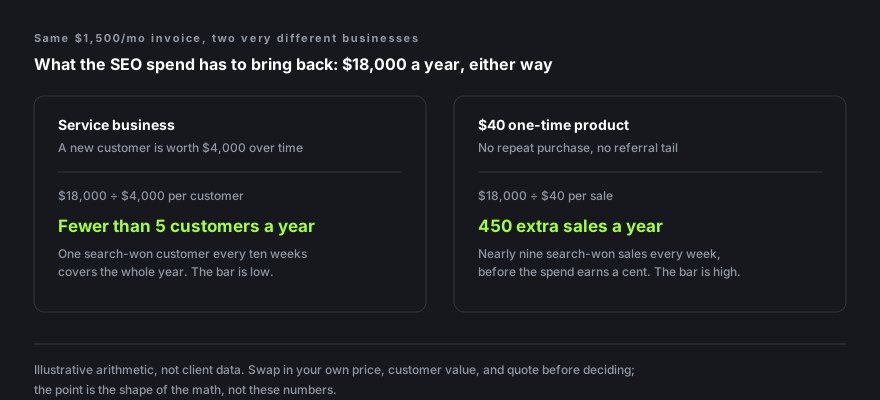
Write your version of it down before any sales call. Monthly cost, times twelve, divided by customer lifetime value. That is how many customers the first year of SEO has to produce just to break even. If the number feels achievable for your niche, condition two passes. If it requires you to double your customer base, it does not.
Condition three: you can wait
Rankings compound, and compounding is slow at the start. A business that needs revenue next month should buy ads, because ads are a tap and SEO is a well. The payoff for digging the well is that it keeps producing after you stop paying for the digging, while the tap shuts off the moment the ad budget does. Plenty of our clients run both: ads for this quarter's pipeline, SEO for every quarter after.
Ads are a tap. SEO is a well. A business that needs water this month should not start by digging.
What has changed in 2026: the same work now feeds AI answers
The newest reason the math favors SEO is that its output now shows up on a second surface. When ChatGPT, Perplexity or Google's AI features answer a buyer's question, they search existing indexes first, and between 37 and 54 percent of the pages Google's AI cites rank in the organic top 10, depending on the study. Google's own documentation says there are no additional requirements to appear in AI Overviews or AI Mode. So a ranking you earn today is also your ticket into the pool AI assistants quote from, at no extra charge. The reverse is not true: nothing you buy that skips ordinary search visibility gets you reliably into AI answers, which is what the evidence on AI visibility levers shows.
When the answer is no
We turn down SEO work in three situations, and you should walk away from any agency that does not. No search demand: your growth channel is elsewhere and SEO money is wasted money. No runway: you need customers now, and the kindest thing anyone can tell you is to buy ads. No margin: the customer value never repays the spend, however well the campaign performs. An agency quoting you a monthly price without asking what a customer is worth to you has skipped the only question that decides whether you should hire them.
Questions owners ask us
How much does SEO cost for a small business?
Anywhere from a few hundred dollars a month for a narrow local campaign to several thousand in competitive niches like legal. The number that matters is not the price, it is the price against your customer lifetime value, which is the arithmetic above. Two warning signs: a price nobody will state up front, and a price that sounds too good against the amount of work described.
Can I do it myself instead of paying?
The fundamentals, yes: a page for each service you offer, plain descriptive page titles, a Google Business Profile you keep current, and asking happy customers for reviews. What is hard to sustain yourself is content production, technical fixes, and honest measurement. Many owners start solo and hire out once the fundamentals stop moving the needle.
Is SEO dead now that people ask AI instead?
The data says the opposite. AI engines search before they answer, and ranking in ordinary search is currently the widest door into their citations. The buyers using AI assistants have not left the market you optimized for. They moved to a surface your SEO already feeds.
My nephew says he can do it for free. Should I let him?
If the site is young and the stakes are low, a careful amateur following Google's own documentation does little harm and learns a lot. The risk is not bad SEO, it is invisible SEO: months pass, nothing is measured, and you cannot tell effort from results. Whoever does the work, insist on the measurement.
Check condition one for free
The free audit shows whether AI engines and search already surface your business for your buyers' questions, or name a competitor instead.
Get my free auditSources
- Google Search Central, "AI features and your website": developers.google.com
- Ahrefs, "38% of AI Overview Citations Pull From The Top 10" (March 2026): ahrefs.com/blog/ai-overview-citations-top-10
- BrightEdge, "Rank Overlap After 16 Months of AIO": brightedge.com
- The payback figures in the diagram are illustrative arithmetic, not client data. Run the formula with your own numbers.