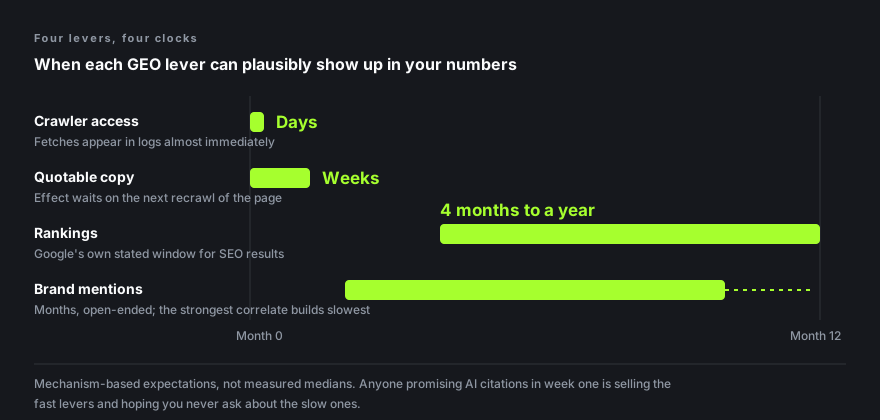
There is no single GEO timeline, because GEO is four different levers with four different clocks. Crawler access fixes take effect in days. Rewriting pages for quotability shows up once the engines re-retrieve those pages, usually within weeks. Ranking improvements follow ordinary SEO time, which Google itself puts at four months to a year. Brand mentions accumulate over months and are the slowest lever of all. Anyone who quotes you one number for "GEO results" without saying which lever they mean is guessing, or selling.
Days: crawler access
The fastest result in this field is fixing a block you did not know you had. If your firewall, bot protection, or a forgotten robots.txt line keeps GPTBot, ClaudeBot or PerplexityBot out, the engines cannot read your pages at answer time, and no other work matters. The fix usually takes minutes, and it takes effect the next time an engine tries to fetch you. This is why crawler access tops our list of levers: it is binary, free, and instant by the standards of everything below.
Weeks: quotable copy
The one lever with controlled evidence behind it is rewriting pages so they state answers plainly, with visible statistics and named sources. The GEO study published at KDD 2024 measured a 22 to 41 percent visibility lift from those edits. The catch for your calendar: the lift applies when an engine retrieves the edited page, so in the wild you wait for the re-crawl and re-retrieval of each page you touched. In our client work we treat 30 days as the sensible first checkpoint after an on-page pass, and we retest then rather than watching daily.
Four months to a year: rankings
Because AI engines search before they answer, and 37 to 54 percent of Google AI citations rank in the organic top 10, a large part of GEO is just ranking, and ranking keeps its old schedule. Google's own hiring guidance, in the "Do you need an SEO?" documentation, says SEOs need "four months to a year" to implement improvements and see potential benefit. That statement is from 2017 and nothing in the AI era has shortened it. New pages targeting the narrow questions fan-out generates sit on this clock too.
Months, open-ended: brand mentions
The strongest brand-level correlate of AI visibility is how much the web talks about you: Ahrefs measured a 0.664 correlation across 75,000 brands, three times stronger than backlinks. It is also the slowest lever, because it means earning coverage, reviews, directory listings and discussion you do not control. PR budget can compress it somewhat. Nothing makes it instant.
Fast levers get you readable. Slow levers get you named. A GEO plan needs both clocks running from day one.
What "seeing results" should mean
The variance problem makes impatience expensive. AI engines answer the same question differently run to run, so checking your favorite prompt once a week is theater: you will celebrate noise and panic over noise. We read appearance as a rate rather than a single answer and compare those rates between test windows. Between those windows, the leading indicators are boring and reliable: AI crawler hits in your server logs, impressions and average position in Search Console for the queries your pages target, and the AI-surface impressions report Google began rolling out to every Search Console property in late August 2026, which counts how often your pages appeared in AI Overviews and AI Mode. That last one has narrow limits. It reports impressions only, with no clicks and no query breakdown, so it is not a traffic number, and an impression is not a citation. All three usually move before the first citation does.
Questions owners ask us
What is the fastest result we could see?
A crawler unblock, if you have a block. It is worth checking first precisely because it is minutes of work with a days-scale payoff, and because a surprising number of sites block AI crawlers by accident through a bot-protection default someone enabled in 2023.
We did a month of GEO and my own test shows nothing. Was it wasted?
A single test cannot tell you. The same prompt returns different answers on different runs, so one check after a month proves nothing in either direction. Compare appearance rates, three runs per prompt per engine, before and after. And check the calendar against the lever: a month is long enough to judge a crawler fix, far too early to judge rankings.
Can we pay more to make it faster?
Partly. On-page work compresses well with more hands. Mentions compress somewhat with PR effort. Rankings barely compress at all, which is why Google's four-months-to-a-year line has survived a decade of people paying to beat it.
Which engine responds fastest?
Engines re-crawl and refresh at different rates, and the honest answer is that we measure it per client rather than promising an order. The pattern we see is that answer-time fetchers pick up page changes faster than rankings move, which is why the quotable-copy lever tends to show first once crawling is open. Treat any confident sitewide ordering you read elsewhere as a guess.
Find out which clock your business is on
The free audit checks crawler access, retrieval and citations across the major engines, and tells you which lever to pull first.
Get my free auditSources
- Google Search Central, "Do you need an SEO?" (the "four months to a year" statement, from Google's "How to hire an SEO" video by Maile Ohye): developers.google.com
- Aggarwal et al., "GEO: Generative Engine Optimization" (KDD 2024): arxiv.org/abs/2311.09735
- Ahrefs, "An Analysis of AI Overview Brand Visibility Factors (75K Brands Studied)": ahrefs.com/blog/ai-overview-brand-correlation
- Ahrefs, "38% of AI Overview Citations Pull From The Top 10" (March 2026): ahrefs.com/blog/ai-overview-citations-top-10
- Search Engine Land, "Google Search Console AI performance reports and Search generative AI control rolling out globally" (August 2026): searchengineland.com
- The timeline bars in the diagram are mechanism-based expectations, not measured medians. Where a lever has a published figure, the figure is cited in its section.