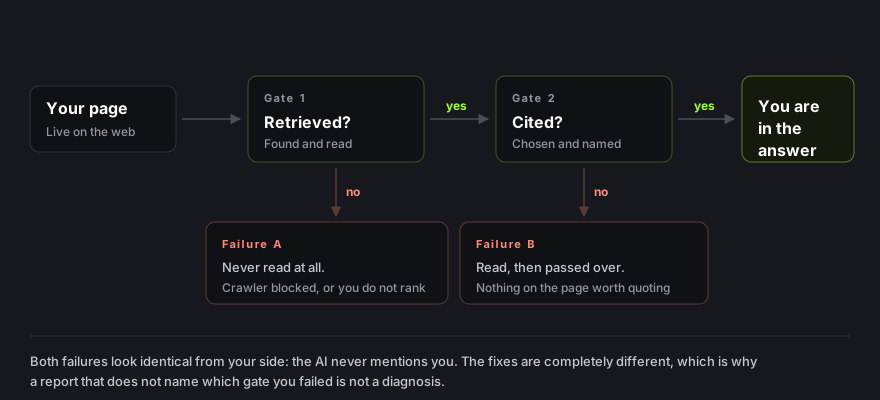
When an AI assistant researches an answer, two separate things have to go right for you. First it has to retrieve your page: find it in a search and actually read it. Then it has to cite you: name your business in the answer a customer sees. These fail for different reasons and they have different fixes. If you were never retrieved, you have an access or discovery problem. If you were retrieved and still not cited, you have a content problem. Almost every AI visibility report on the market collapses these into one number, "you didn't appear," which tells you nothing about which problem to fix or what fixing it costs.
Two doors, two failures
Think of an AI answer as a room with two doors. The first door is retrieval. The engine fans your customer's question out into several searches, pulls back a pool of pages, and reads some of them. The second door is citation. Out of the pages it read, it names two or three in the answer.
Failure one: never retrieved
Your page was not in the pool at all. The usual causes are mechanical. Your site blocks the AI crawlers at the door, or your pages do not rank for any of the fan-out searches the engine ran, or the page that should answer the question does not exist. This failure is invisible from the outside, and no amount of rewriting your copy fixes it, because nobody is reading the copy.
Failure two: retrieved, then passed over
This one stings more. The assistant fetched your page, read it, and built its answer citing someone else. Your content was in the room and lost the comparison. Usually the page it preferred had something concrete to take: a number, a clearly stated answer, a named source, a price.
An assistant read your page, decided against naming you, and nobody told you it happened.
Which door is closed on your site? The free audit logs fetched and cited separately, per engine, so you find out which problem you actually have.
Get my free auditWhy the distinction is worth money
Because the fixes have completely different price tags, and buying the wrong one is the most common waste we see.
- A business with a retrieval problem that buys content rewrites is paying to polish pages no engine reads. The actual fix might be a crawler permission, or a handful of pages targeting the fan-out searches, some of it under an hour of work.
- A business with a citation problem that buys technical SEO is tuning a site the engines already read happily. The actual fix is on the page: state the answer, show the numbers, cite the sources.
For the citation side, there is controlled evidence about what works. Researchers from Princeton, Georgia Tech and IIT Delhi tested nine optimization methods across 10,000 queries in the GEO paper published at KDD 2024. In those controlled tests, adding quotations, statistics and cited sources to visible text lifted a page's word share in AI answers by 30 to 40 percent. On live Perplexity the best method, quotations, gained 22 percent. The "up to 40 percent" that gets quoted everywhere is the top of the benchmark result, and the live engine gave less. Keyword stuffing, in the same tests, did roughly nothing.
How we tell them apart
You cannot separate retrieved from cited by looking at the answer a customer sees. The answer only shows citations. Our audit protocol observes the research step itself: for each buying question, we record which searches the engine ran, which pages it pulled, and which of those made it into the final answer, with appearance measured as a rate so a lucky answer cannot mislead us. Your report then says one of three things about each question, and each has a known fix:
- Not retrieved. Fix access and coverage first. Content spend is wasted here.
- Retrieved, not cited. Fix the page. Make it the most quotable document in the pool.
- Cited. Protect it. Keep the page fresh and watch competitors trying to displace you.
Find out which failure you have
The free audit tells you, question by question, whether the engines are reading you and skipping you, or not reading you at all.
Get my free auditSources
- Aggarwal et al., "GEO: Generative Engine Optimization" (KDD 2024): arxiv.org/abs/2311.09735
- Google, "AI in Search: Going beyond information to intelligence" (query fan-out): blog.google