A lead who is about to sign with you does one more thing first. They open ChatGPT or Perplexity and type your name, usually with the words "reviews" or "worth it" after it. Whatever comes back is the last thing they read before the decision. Most AI visibility reports stop at whether the assistant named you. Ours now reads what it said, because a mention that carries a warning sends the lead to whoever the answer named next. This article explains how that read works, what the four labels mean, and why every quote in the report is copied from the answer rather than written by us.
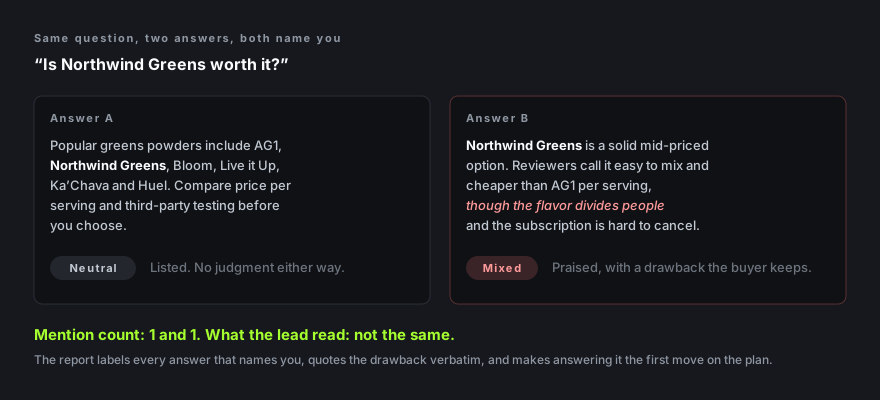
Named is not the same as recommended
An appearance rate tells you how often an assistant brings you up. It says nothing about the sentence it brings you up in. "Northwind Greens is a solid mid-priced option" and "Northwind Greens is fine, though the flavor divides people" both count as one mention. The buyer reads them very differently. In the audits we have run, the answers that name a business split roughly into three kinds: a plain listing with no judgment, a recommendation with the reasons stated, and a recommendation with a caveat attached. The caveat is the part that matters, because it is the objection the lead will bring to your call, or the reason they never book one.
The four labels
Every recorded answer that names you gets one of four reads. The definitions are fixed so that two audits a month apart are comparable.
- Favorable. The answer recommends you or describes you well, with no material caveat.
- Neutral. You are listed or described factually, with no judgment either way. Common in "here are six options" answers.
- Mixed. Praise and a real drawback both appear. This is the most frequent read for an established brand, and the most useful.
- Negative. The answer steers the buyer away from you, or the drawbacks dominate.
For mixed and negative reads the report also states the concern in one plain sentence, and lists the descriptors the answer itself used for you, so you can see the words you are being sold with. Those descriptors are worth reading twice: they are the phrases a buyer will repeat back to you as if they were their own opinion.
Every quote is copied, none is written
The read is done by a reader model that sees the stored answer and the name of the brand, and returns a label, a quote, and the concern. The quote is then checked against the stored answer, character for character allowing for typographic quotes and spacing, and dropped if it is not there. The report can show a label with no quote. It can never show a quote the assistant did not say. This matters because the whole point of the section is to put the buyer's actual reading in front of you, and a paraphrase would defeat that.
Two more rules keep the read honest. A drawback the answer states about a whole category of product is not a drawback of your brand: "PEO fees rarely make sense under five employees" is a comment on PEOs, not on the one PEO the answer happened to name. The reader is told to label that neutral. And the reader reports its own confidence. A concern it was unsure about still prints in the section, marked as a weak read, but it never leads the plan page. The first move on your plan cannot rest on a label the reader itself doubted.
A mention that carries a warning does not help you close. It helps whoever the answer named next.
What the answer is built from
The assistant did not form an opinion of you. It searched, read a handful of pages, and summarized what they said. So a caveat in the answer traces back to a page: a review thread, a comparison post, a competitor's "alternatives to" article, or your own pricing page saying less than it should. Ahrefs' study of 75,000 brands found that how often a brand is mentioned across the web is the factor most strongly tied to its AI Overview visibility, which is one reason the words those mentions use end up in the answer. The same mechanism that decides whether you are named decides how you are described.
Because the answer changes between runs, the read follows the same rule as the rest of the audit: appearance is read as a rate, not a single answer, and the report shows the favorable and mixed-or-negative counts per engine, not a single screenshot. A caveat that appears in one run of nine is a risk. One that appears in seven of nine is your reputation, as far as that assistant is concerned.
What to do with a mixed read
The report turns the strongest concern into the first move on the plan, and the move is almost always a page. If the concern is price, the fix is a pricing page that states the number and who it is wrong for. If the concern is a comparison with a named competitor, the fix is your own comparison page, written straight, that the assistant can read instead of theirs. If the concern comes from an old review, the fix is a current page that says what changed. The assistants reward a stated answer over a hedge, and the caveat they attach to you today is the one nobody has answered in writing yet.
One honest limit. For audits recorded before September 2026, the read is based on the passages of each answer around your name rather than the full answer, and the report says so where it applies. Full-answer reads are the standard from here on.
See what AI says about you, in its words
Every answer in our free audit that names you is labeled and quoted. You see the favorable count, the concerns, and the page that answers each one.
Get my free auditSources
- Ahrefs, "An Analysis of AI Overview Brand Visibility Factors (75K Brands Studied)": ahrefs.com
- Google, "AI in Search: Going beyond information to intelligence" (how answers are assembled from retrieved pages): blog.google
- The Northwind Greens examples in this article are illustrative. The label definitions and the quote rule are the ones used in every EZ Web audit; see the methodology page.